Showing posts with label tips. Show all posts

CROUTONS: COME TO MAMA


There are a number of ways to use up old crusty bread -- there's french toast breakfasts, pulverising them into bread crumbs, making a topping for a savory casserole,  etc.  but nothing beats fresh croutons, in my mind.  They pack such a flavor punch and are the key to making a salad into a hearty meal.  They are like wee dressing sponges, soaking up the aromas and sass of the vinaigrette and making each bite burst with excitement.

Making croutons is also so lazy and easy -- such a high reward for such a low effort (if only lots more things in life worked this way, we'd all be crouton geniuses!).

Just grab your leftover toast or over-the-hill bread, dice into 1/2 inch or so cubes.  Toss in a smidgen of olive oil, season with salt and pepper, paprika and garlic powder if you are feeling fancy.  Spread onto a baking sheet and cook for about 7 minutes at 375 or for about 2-3 minutes under the broiler.  Just make sure to watch for them (and smell too!), because although I love crustyness, char-burnt just won't do.

Toss with your favorite salad (D and I are currently obsessed with Cesar) and voila. 

TIP: INFUSE OIL WITH GARLIC SLIVERS BEFORE FRYING UP LUNCH


I had the pleasure of hanging out in one of the most luxurious kitchens in all of Portland a few days ago -- In such good company, Adrian and Sasha.  I photographed, we lounged and talked about food and Portland . . . all the while Adrian prepared us the most delicious and simple of lunches -- sauteed zucchini on a bed of creamy polenta.  She deftly cooked while chatting (a multi-tasking feat I don't quite have down) . . . And I noticed a little detail, she sauteed slivers of fresh garlic, removed them when they turned golden, then threw the zucchini in the hot pan.  The resulting vegetable had the whisper of garlic and freshness, without being too overpowering in flavor.  It was heavenly!

ASPARAGUS: I LOVE YOU


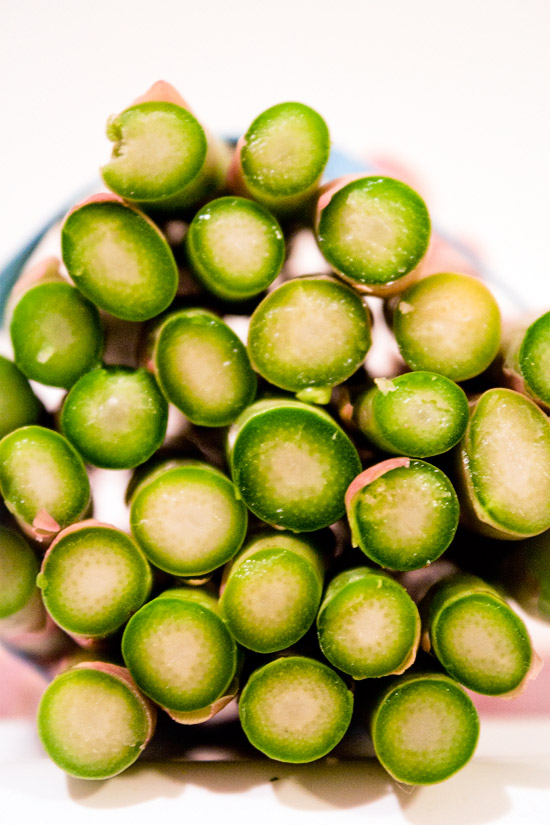
Yes, you are totally out of season and criminally expensive at the grocery store.  Yet I still buy you, of the curvaceous lengthy stems, bursting forth with verdant health and the promise of spring time.  Asparagus, you are the most delectable when blanched for 20 seconds, bathed in ice, then tossed in the sexiest olive oil around, sprinkled with truffle salt.  No more, no less.  You are indulgence one can feel virtuous about. Clearly, I am in love.  So is D.  It's getting serious.

ON SAMPLING


We have a Whole Foods about half a mile a way.  They always have red grapes to taste.  This evening, D and I found ourselves in the fancy Whole Foods across town, grabbing a bite before a lecture on Forensic Anthropology (it was sold out though -- such a bummer).  Amidst building an expansive and expensive salad, we plucked many grapes.  We tossed them down the hatch, one by one, until I grabbed a handful and Dave winced with glee and embarrassment. 

I'm what I think of as a liberal sampler.  I go hard, it's free!  I have a hard time not tasting an item if it's out for display.  This is the girl who just had to swipe her index finger on the back of all wedding cakes as a kid, went to Costco (sampling strange and absurd foods, to be sure) for lunch in college and now grazes heartily at the Farmer's Market.  I love being in the rest of the world's bustling markets, where sampling is the norm and you must 'taste taste.' I've fell in love with many odd foods this way -- custard apples, salep (a Turkish hot drink made of milk, cinnamon and powdered orchid root) and tofu skins to name a few.

Fall grapes -- they're made for tasting! 

LITTLE THINGS: CURRY LEAVES


Have you ever seen a curry leaf?  They are fragrant and gorgeous fresh and I've never been able to find them outside of India.  Until now!  They have a nutty, bold flavor that is impossible to replicate and I've always missed having the real-deal on hand.  Gone are my curry leaf-deprived days -- Hooray!  If you can find them, and I did at an Asian Grocery near our house, just crush about 5 leaves into any lentils, rice or curry to unlock a truly South Indian taste.  They cost 1.99 (many more rupees than I'm used to paying) and keep for up to a week in a plastic tub.  I'm so happy!

LITTLE THINGS: MAKE YOUR OWN ALMOND MILK


(the almonds prepare to get whizzed in the blender, then poured into the mason jar)


(almonds really are so beautiful)

The air has shifted to a few degrees cooler. The birds aren't peeping quite so early when I rise. The moon hangs in the morning sky, along with the sun. I'm wearing sweat pants. It even drizzled a little today on my walk. Fall is not only coming, it's kinda here . . .

I love to celebrate all the seasons, it's one of the reasons I'm grateful to live in the Pacific NW, instead of the perfect Southern California weather I grew up in. But the truth is that Fall is my favorite. I consider it the best time of year! The flavors, scarves, crisp air, changing leaves and the time to go inward with projects and new ideas. Perhaps it's the school girl still within me, but the beginning of September brings me great joy and renewed focus.

So it was serendipitous that I met Diana Stobo, a cookbook author and culinary artist at the Farmer's Market, then again at Whole Foods. Diana is a raw food advocate bursting with nutritional knowledge, positivity, a human attitude (not dogmatic) to eating well, and many approachable and easy raw vegan recipes to share. I loved her book, Get Naked Fast, and it's relaxed attitude towards optimum wellness and healing through healthy eating.

Diana's book and her raw recipes renewed my interest in healthy eating and gave me lots of new ideas for delicious and healthful things to eat -- this was great timing, as the Fall is fast-approaching and I was feeling a bit in a food rut . . .

The first recipe I turned to was one for almond milk. I buy almond milk once per week and drink it in my tea, pour it onto my cereal and sometimes add it to soups and smoothies and I'm embarrassed to say it never occurred to me to make my own. Of course I should make some! YES! That's how I felt when I saw the simple recipe.

I got crackin . . .

The results? REALLY REALLY NICE. So fresh. So pure.

Almond Milk
(adapted from Diana Stobo's, Get Naked Fast)
1 c almonds, soaked for 12 hours in a bowl of water
4 cups water
pinch of salt

Directions:
Place almonds in a bowl, top with water, cover and let sit for 12 hours (I did mine overnight). Place soaked almonds in a blender, pour four cups of water over it, throw the salt in and whizz on high speed for about 30 seconds to a minute. Mixture will turn white and frothy. Pour almond milk through a nut bag, over a large pitcher or container. Squeeze out the almond remains and pour into a 1 quart jar with a lid. Really nice chilled.

*I think next time I may sweeten mine with a date or a little honey. And add a little vanilla bean.

LITTLE THINGS: ROASTED BELL PEPPERS


(the peppers are out of control at the farmers' markets right now -- awh glorious summer!)

I have always enjoyed roasted bell peppers -- strips on a sandwich, mingling on top of a pizza with some red onion or just straight from the jar, as I ponder the fridge for something 'real' to eat. For some silly reason, I didn't make them very often, as I associated the method with fire, setting them directly over a flame and for so long, D and I had an electric -- my beloved roasted pepper seemed just out of reach. Foolish girl I was!

Well, all that changed when I decided to fire up the oven (duh) to broil or about 450 degrees, whatever you feel comfortable with, put about 4 down on a pan and listen to 'em pop and crackle. They turned pleasantly dark in a matter of about 30-40 minutes, I rotated them with a pair of tongs about every 10-15 -- just casually when I noticed they were really poppin. Then, I slipped these charred beauties into a bowl with a lid and let them sweat for about 5 more minutes, then they were ready to be skinned and cut into slivers-- that's a bingo!

So easy and much tastier than those from a jar. You could throw a drizzle of olive oil on them and they'd keep for a while in the fridge, just waiting to be thrown into a pasta, pureed into a sauce, grace a piece of avocado toast (such a good combo!) or, as I so aimlessly do, while staring into the fridge looking for inspiration. It's the little things like this that you can have on hand that make a piece of toast into a meal -- not just an afternoon nosh.

Inch by Inch . . . Row by Row


Gonna make that garden grow . . . You know the rest of the song.  But really, how does a garden grow?  Did someone ever teach you?  It seems like more and more vegetable gardens are popping up in residential, commercial and academic spaces -- 

In Portland, there is even a Learning Garden Laboratory, 11 acres of educational garden education.  I have a good friend, Beret, who is one of the care-taker/educators at this amazing site -- She teaches classes to students ranging from 6th-graders to master gardeners.  Here’s what she has to say about growing that good stuff and eating it!


1.) What exactly is a “Learning Garden?”

A learning garden is an educational facility, where students come and learn about where their food comes from. The Learning Gardens Laboratory is a 12-acre site in SE Portland. It is currently used to education Portland State Students, Oregon State Extension Urban Horticulture Students and Master Gardeners, Lane Middle School Students, S.U.N program participants, and Community Transition School Students all of whom come to the garden to learn about how to grow food and often use the food in their school cafeterias or learn how to cook it themselves. The idea is to provide hands-on education, and improve student’s health and wellbeing. Learning gardens are essentially “living laboratories” or places to study the science of ecology.  They provide a great environment to learn about interconnection, cycles, interdependence, diversity, patterns, balance and systems. Plus they are fun places to check out bugs, compost, plants, flowers, food, birds and dirt!


2.) How do you relate every-day foods to plants that grow out of the Earth?

Ever since becoming a gardener I am much more aware of food and the state it’s in when I buy it. I feel the healthiest when I am eating fresh food and I love to support local farms when ever possible. Eating well and cooking healthy food is a constant challenge for me as it is for most people, and I hope that more and more people are able to access support to learn about how to cook and prepare fresh foods in simple ways. For this reason learning gardens are important because children are learning these important lessons and skills right from the start rather then later in life.


3.) Describe the taste of foods that come out of the learning garden . . .

Satisfying and Fresh! Satisfying because the food is the product of a labor of love and fresh because it hasn’t traveled in a truck or sat on a shelf, it tastes exactly as it should taste.


4.) I recently heard that the Learning Gardens may be growing foods for Portland Public Schools – how’s that going?

We are growing food to donate to the Portland Public School’s Harvest of the Month program. In this program the school cafeteria features one locally grown crop each month. They source the food from small, local producers and promote the item with posters and activity sheets given to all of the schools. This spring we grew radishes for the April Harvest of the Month, but due to a rainy spell, most were not ready until April 30th! That’s one of the challenges with creating a schedule based around crops, the weather may not cooperate! We also donate food to the Lane Middle school cafeteria. The students from Lane Middle School come to the garden and will often take produce back to their school food service personnel to prepare for lunch.


5.) What are some tips that we novice gardener/cooks can take away form the Learning Gardens?

Support your local school garden programs, they are great educational tools and kids love them! Encourage your local school to start a garden! Find ways to incorporate cooking into garden programs. Invite local chefs to be a part of gardening programs, ask your kids what they are growing at school and prepare those foods at home. Encourage your kids to try new foods and grow some of their favorite food at home. If you have children in Portland Public Schools buy the “local” lunch they offer once a month as a part of the harvest of the month program. If you want to start a garden at home, start small, and plant the things you and your family really love to eat. Remember gardening is a process not an event. Take good notes and make lots of observations! If you can, shop at farmers markets to find quality, locally grown, fresh produce.


6.)  Any final thoughts or future plans for the Learning Gardens?

The dream for the Learning Gardens Laboratory is to become a model site for garden based education in the Pacific Northwest as well as the nation. We hope to find funding to hire staff and improve our infrastructure. Our existing greenhouses are worn out and we don’t have a classroom, office or kitchen. We hope to build a new greenhouse, offices, and a kitchen/classroom and a commercial kitchen. This will allow us to expand our programming to more students in the neighborhood and be able to offer nutrition and cooking education using the things we grow on site.

Many thanks to Beret for sharing her thoughts!